c.curionodeThe Turing Archive

1977 · Languages & software

From formulas to working programs

FORTRAN helped scientific programmers express calculations at a higher level.

1977Turing Award
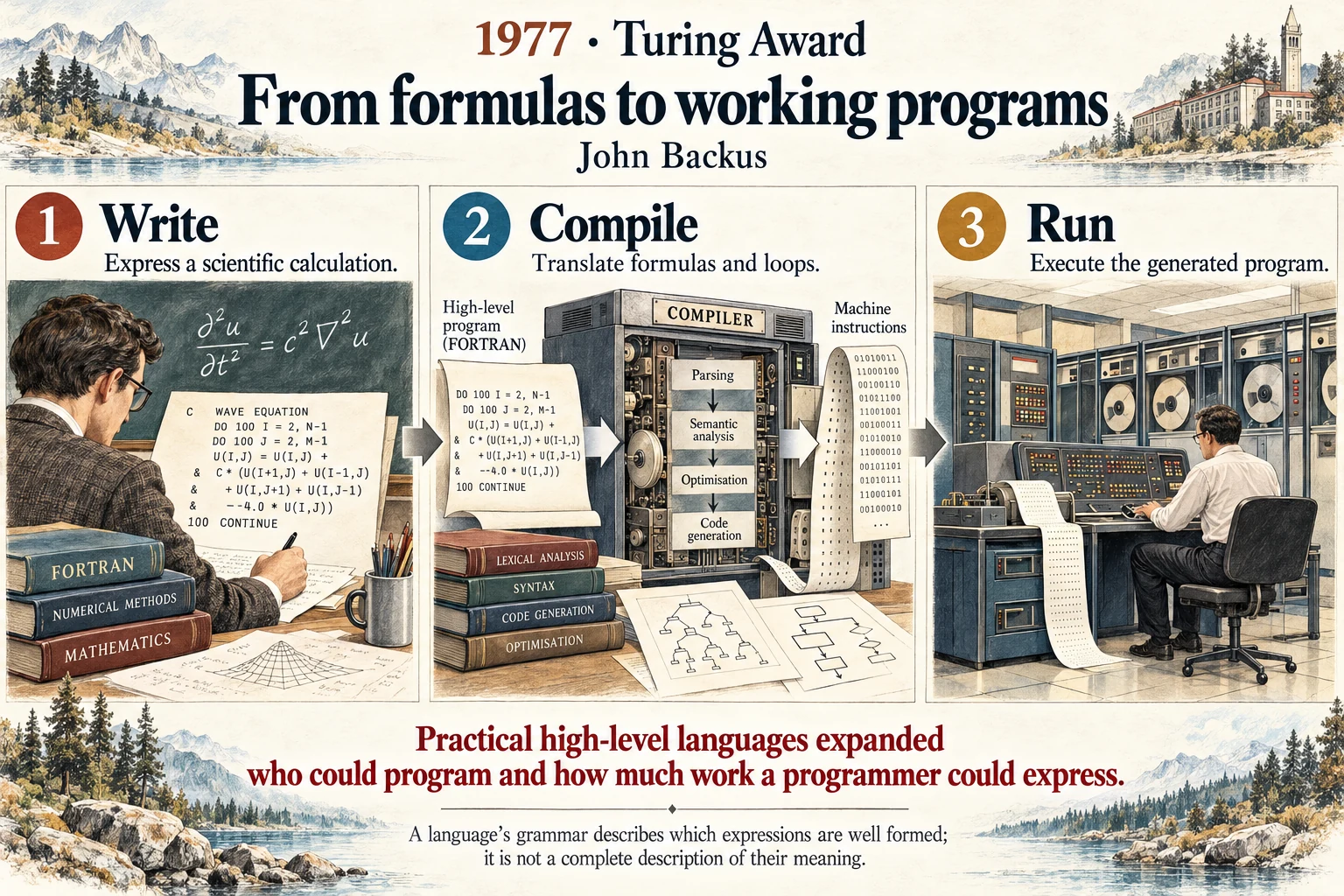
From formulas to working programs: FORTRAN helped scientific programmers express calculations at a higher level.
Original AI-generated infographic by Curionode. Read the text version below for the full explanation.
Read the poster text
  1. Write

    Express a scientific calculation.

  2. Compile

    Translate formulas and loops.

  3. Run

    Execute the generated program.

Practical high-level languages expanded who could program and how much work a programmer could express.

A language’s grammar describes which expressions are well formed; it is not a complete description of their meaning.

01 · The idea

In everyday language

John Backus led the development of FORTRAN at IBM. Scientific formulas and loops could be translated into efficient machine instructions, reducing the need to write assembly language for every calculation. His work also influenced the formal description of programming-language syntax through the notation associated with Backus and Peter Naur.

Why it matters

Practical high-level languages expanded who could program and how much work a programmer could express.

02 · The people

Who brought the idea to life?

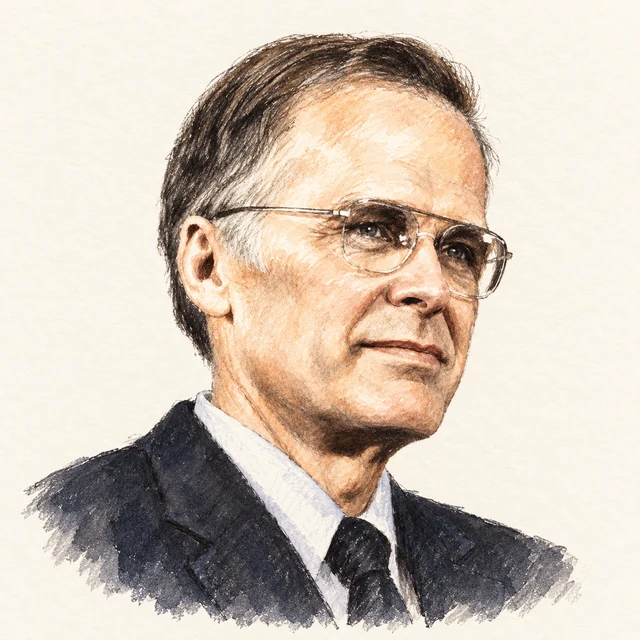
Illustrated portrait of John Backus

John Backus

John Backus led the IBM team that created FORTRAN, making high-level programming practical for scientific computation. The project combined a more accessible language with a compiler capable of producing efficient machine code. He also contributed to the formal description of programming-language syntax and later explored functional programming. His career showed how language design could change both everyday programming practice and the questions computer scientists ask.

Read the biography ↗

03 · Read further

From the original sources

Original explanations based on the official award record. The subject label is an editorial navigation aid.

  1. Official ACM profile: John Backus ↗amturing.acm.org
  2. Heidelberg Laureate Forum: John Backus ↗www.heidelberg-laureate-forum.org