c.curionodeThe Turing Archive

1966 · Languages & software

Teaching a computer our language

Compilers let people express a calculation without writing every machine instruction.

1966Turing Award
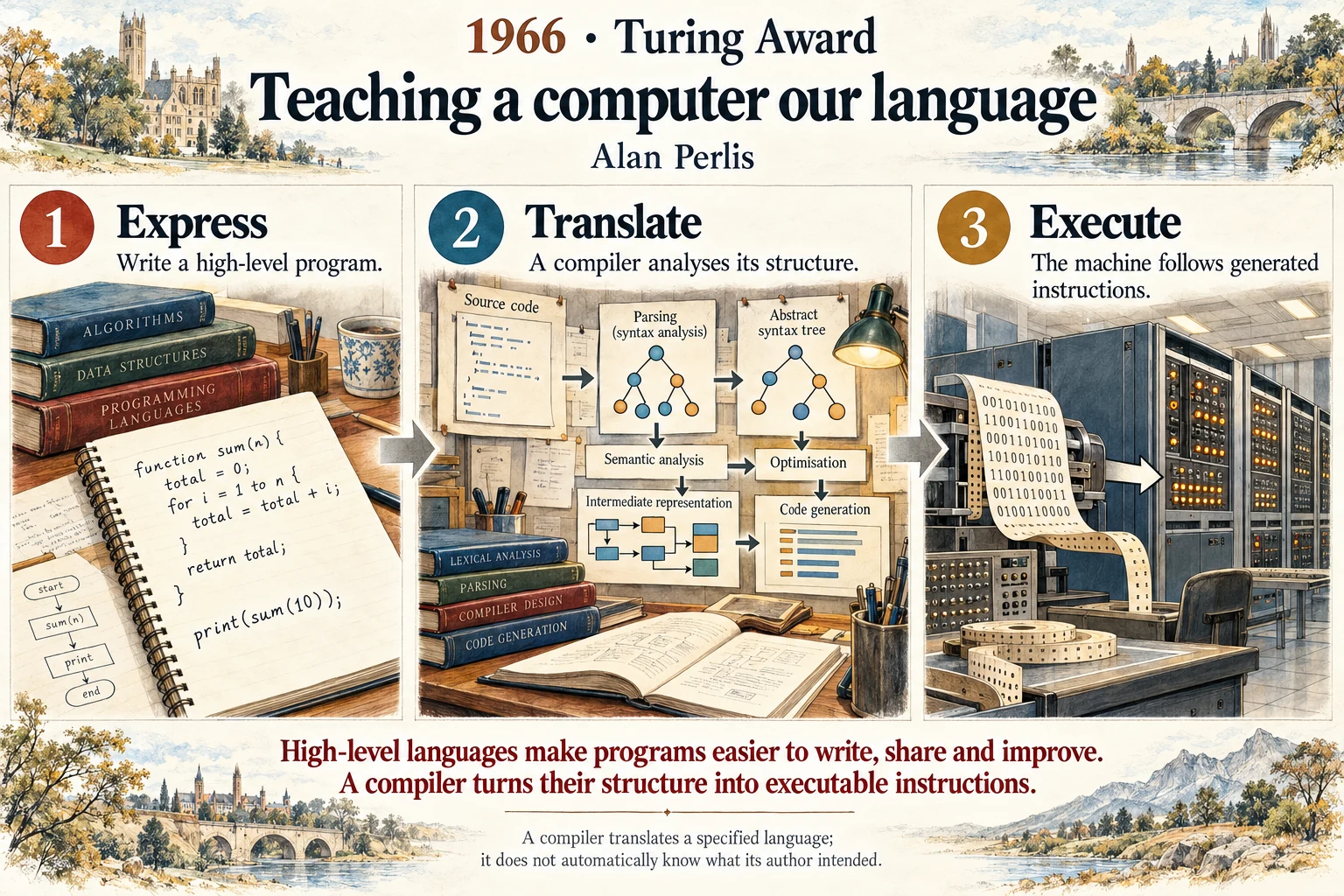
Teaching a computer our language: Compilers let people express a calculation without writing every machine instruction.
Original AI-generated infographic by Curionode. Read the text version below for the full explanation.
Read the poster text
  1. Express

    Write a high-level program.

  2. Translate

    A compiler analyses its structure.

  3. Execute

    The machine follows generated instructions.

High-level languages make programs easier to write, share and improve. A compiler turns their structure into executable instructions.

A compiler translates a specified language; it does not automatically know what its author intended.

01 · The idea

In everyday language

A computer executes very small operations. A programmer usually wants to describe a larger idea: repeat a calculation, organise a table, or call a reusable procedure. Alan Perlis helped establish the programming techniques and compiler construction that connect those two levels. The inaugural Turing Award recognised this bridge between human expression and machine execution.

Why it matters

High-level languages make programs easier to write, share and improve. A compiler turns their structure into executable instructions.

02 · The people

Who brought the idea to life?

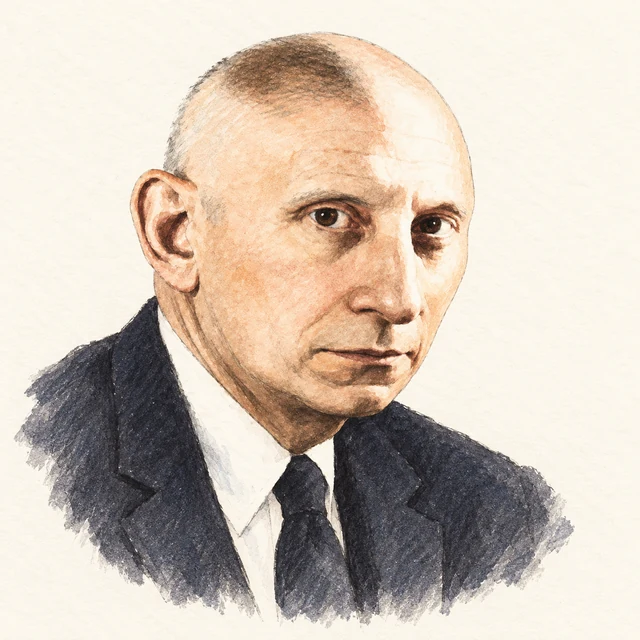
Illustrated portrait of Alan Perlis

Alan Perlis

Alan Perlis helped turn programming into an academic discipline. At Carnegie Institute of Technology, he led the computation center and became the first head of its computer science department. His work on early compilers and the international ALGOL language effort connected mathematical ideas with practical programming. The inaugural Turing Award recognized his influence on advanced programming techniques and compiler construction.

Read the biography ↗

03 · Read further

From the original sources

Original explanations based on the official award record. The subject label is an editorial navigation aid.

  1. Official ACM profile: Alan Perlis ↗amturing.acm.org
  2. Heidelberg Laureate Forum: Alan Perlis ↗www.heidelberg-laureate-forum.org