c.curionodeThe Turing Archive

1968 · Theory & algorithms

When a bit goes wrong

Extra structure can reveal—and sometimes repair—errors in digital information.

1968Turing Award
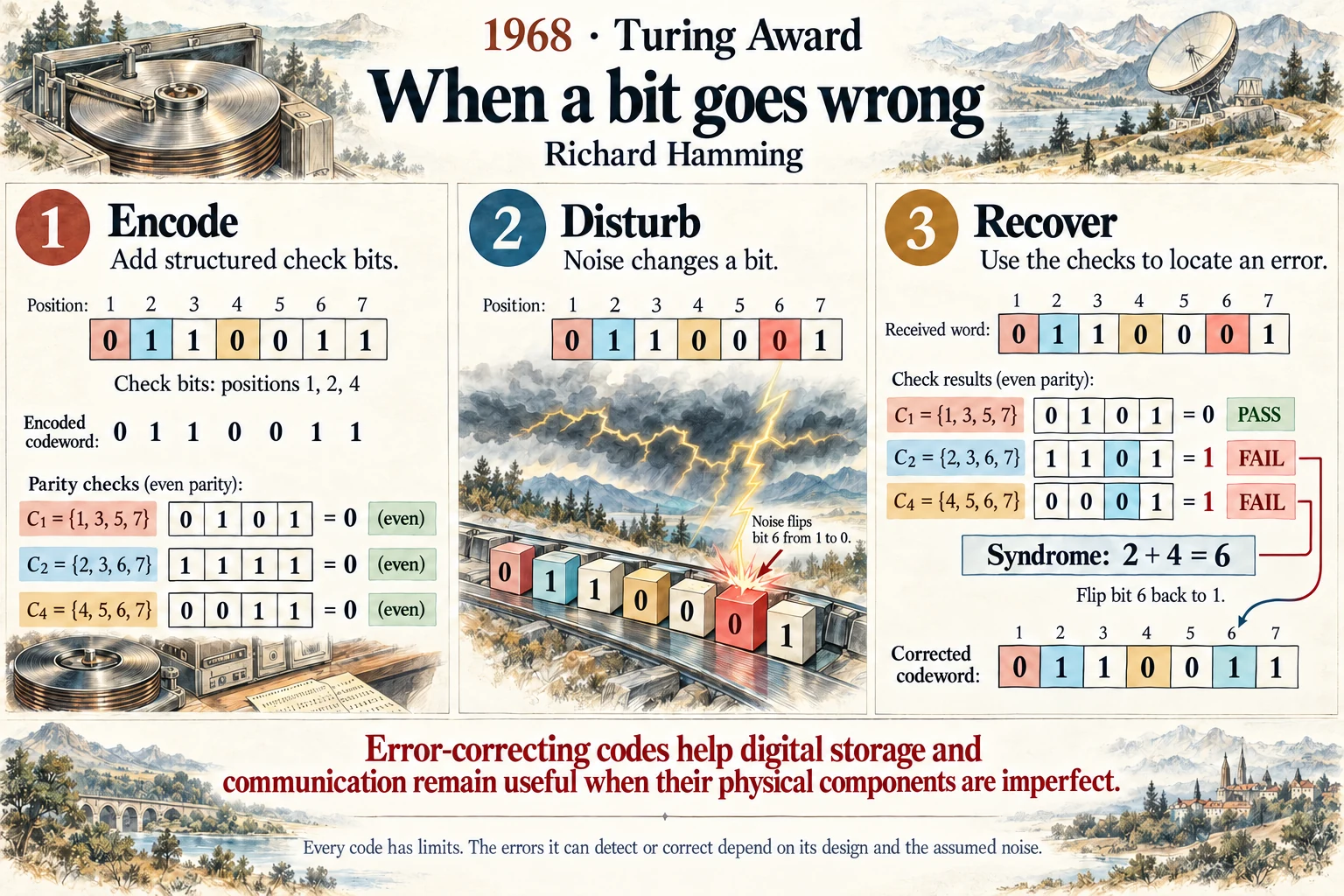
When a bit goes wrong: Extra structure can reveal—and sometimes repair—errors in digital information.
Original AI-generated infographic by Curionode. Read the text version below for the full explanation.
Read the poster text
  1. Encode

    Add structured check bits.

  2. Disturb

    Noise changes a bit.

  3. Recover

    Use the checks to locate an error.

Error-correcting codes help digital storage and communication remain useful when their physical components are imperfect.


Every code has limits. The errors it can detect or correct depend on its design and the assumed noise.

01 · The idea

In everyday language

A damaged bit can change a number or corrupt a message. Richard Hamming showed how carefully chosen redundant bits can make some errors detectable and correctable. His award also recognised numerical methods and automatic coding systems: several ways to make computation more dependable.

Why it matters

Error-correcting codes help digital storage and communication remain useful when their physical components are imperfect.

02 · The people

Who brought the idea to life?

Illustrated portrait of Richard Hamming

Richard Hamming

Richard Hamming was a mathematician whose work made digital computation more reliable. At Bell Laboratories he developed error-correcting codes that add structured redundancy to information, allowing certain damaged bits to be identified and repaired. He also worked on numerical methods and automatic programming. His Turing Award recognized this broader combination of contributions, rather than error correction alone, and his teaching influenced generations of engineers.

Read the biography ↗

03 · Read further

From the original sources

Original explanations based on the official award record. The subject label is an editorial navigation aid.

  1. Official ACM profile: Richard Hamming ↗amturing.acm.org
  2. Heidelberg Laureate Forum: Richard Hamming ↗www.heidelberg-laureate-forum.org