c.curionodeThe Turing Archive

1970 · Theory & algorithms

How wrong is a computed answer?

Backward error analysis made rounding errors something we could reason about.

1970Turing Award
How wrong is a computed answer?: Backward error analysis made rounding errors something we could reason about.
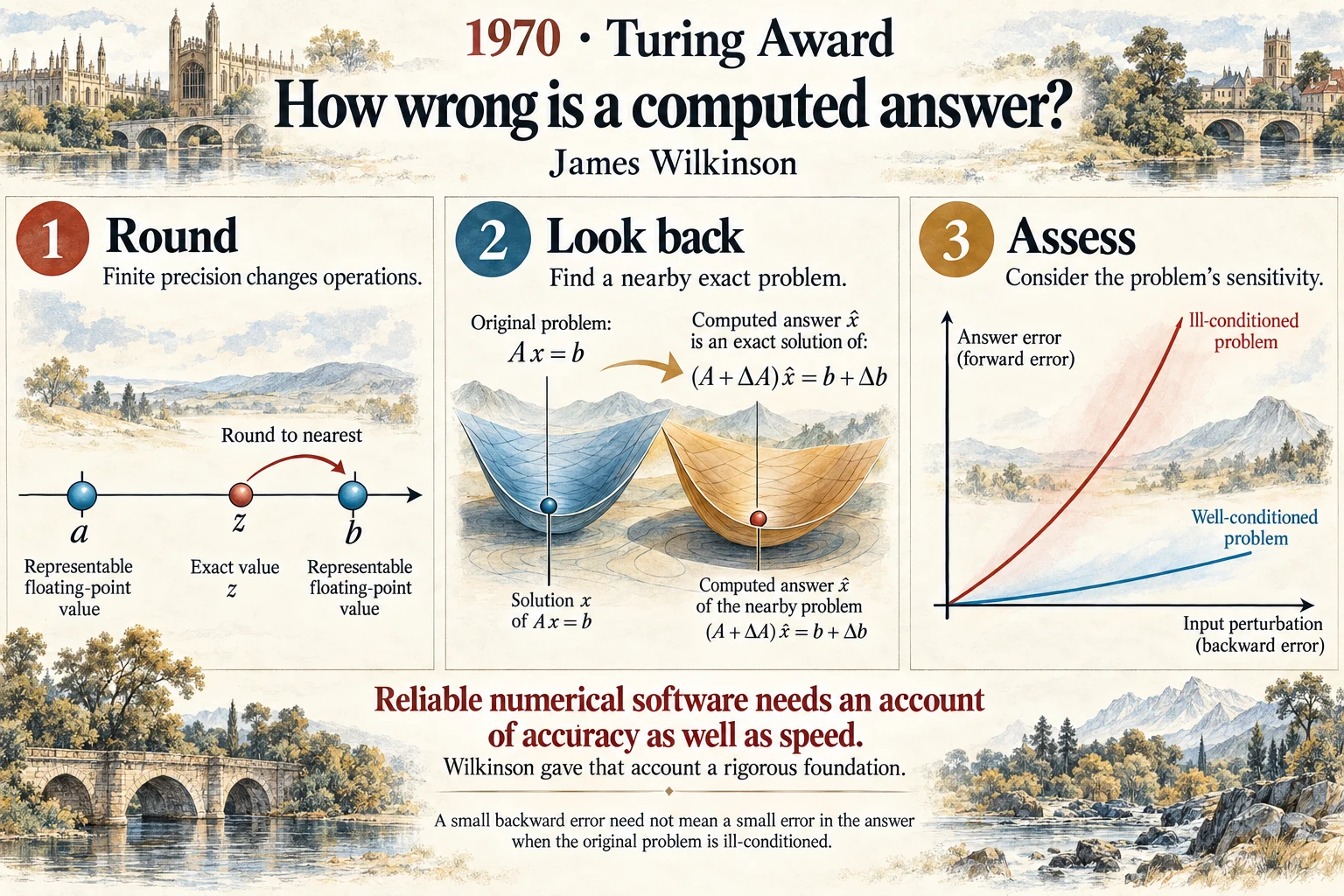
Original AI-generated infographic by Curionode. Read the text version below for the full explanation.
Read the poster text
  1. Round

    Finite precision changes operations.

  2. Look back

    Find a nearby exact problem.

  3. Assess

    Consider the problem’s sensitivity.

Reliable numerical software needs an account of accuracy as well as speed. Wilkinson gave that account a rigorous foundation.


A small backward error need not mean a small error in the answer when the original problem is ill-conditioned.

01 · The idea

In everyday language

Computers represent numbers with finite precision. James Wilkinson studied the small rounding errors that accumulate in numerical calculations, especially in linear algebra. Backward error analysis asks whether a computed answer is the exact solution to a nearby problem. This separates the behaviour of an algorithm from a problem’s sensitivity to its input.

Why it matters

Reliable numerical software needs an account of accuracy as well as speed. Wilkinson gave that account a rigorous foundation.

02 · The people

Who brought the idea to life?

Illustrated portrait of James Wilkinson

James Wilkinson

James Wilkinson worked at Britain’s National Physical Laboratory, first helping develop electronic computing with Alan Turing and then becoming a leading numerical analyst. He studied how rounding errors affect calculations in linear algebra. His backward error analysis explains a computed answer as the exact solution to a slightly changed problem, giving scientists a practical way to judge numerical reliability on real computers.

Read the biography ↗

03 · Read further

From the original sources

Original explanations based on the official award record. The subject label is an editorial navigation aid.

  1. Official ACM profile: James Wilkinson ↗amturing.acm.org
  2. Heidelberg Laureate Forum: James Wilkinson ↗www.heidelberg-laureate-forum.org