c.curionodeThe Turing Archive

2000 · Theory & algorithms

What must two computers tell each other?

Communication, randomness and secrecy became questions with mathematical resource bounds.

2000Turing Award
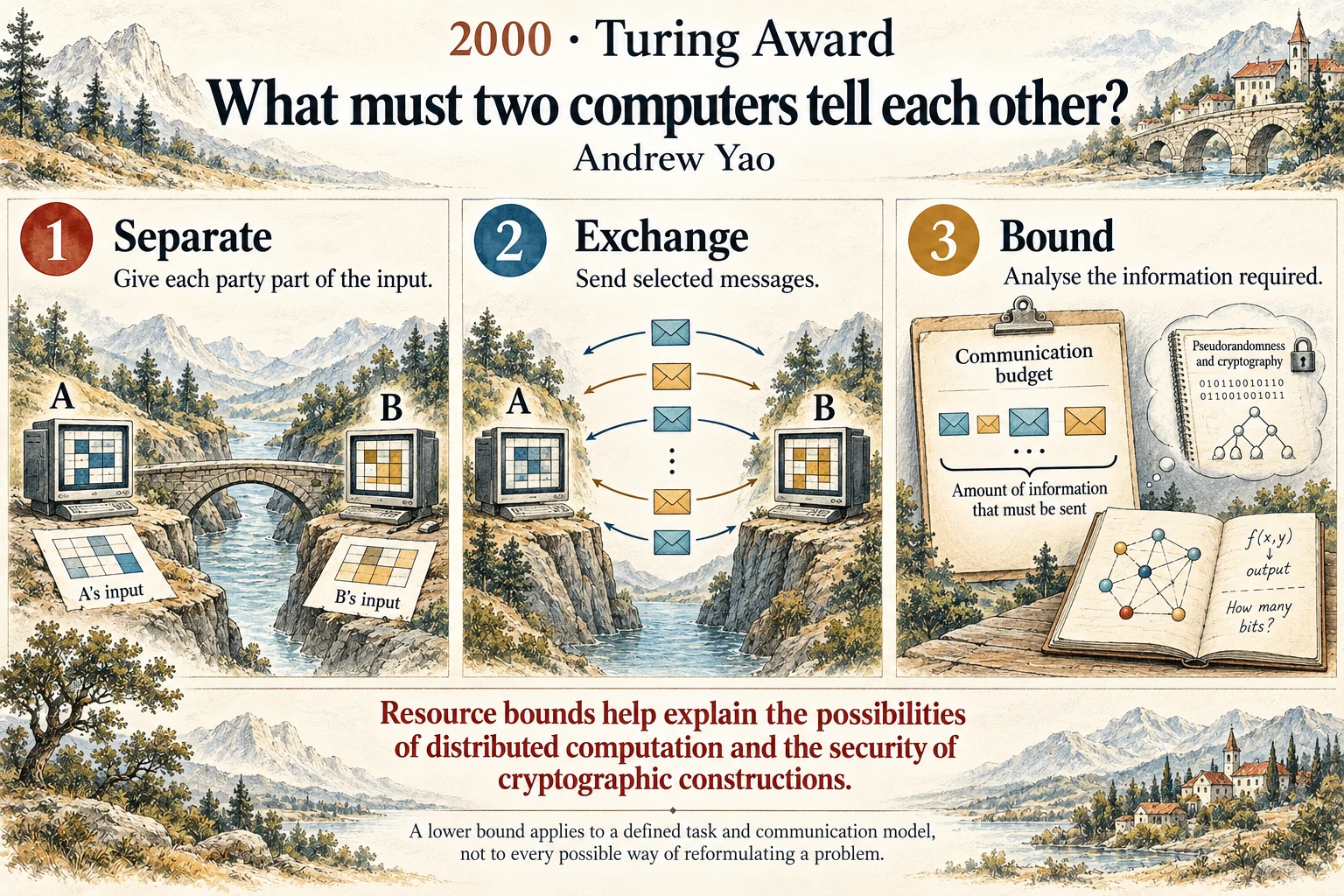
What must two computers tell each other?: Communication, randomness and secrecy became questions with mathematical resource bounds.
Original AI-generated infographic by Curionode. Read the text version below for the full explanation.
Read the poster text
  1. Separate

    Give each party part of the input.

  2. Exchange

    Send selected messages.

  3. Bound

    Analyse the information required.

Resource bounds help explain the possibilities of distributed computation and the security of cryptographic constructions.
A lower bound applies to a defined task and communication model, not to every possible way of reformulating a problem.

01 · The idea

In everyday language

Andrew Yao developed foundations across the theory of computation, including communication complexity, pseudorandomness and cryptography. If two participants each hold part of an input, how much must they communicate to compute an answer? Such questions reveal limits that are not captured by counting processor operations alone.

Why it matters

Resource bounds help explain the possibilities of distributed computation and the security of cryptographic constructions.

02 · The people

Who brought the idea to life?

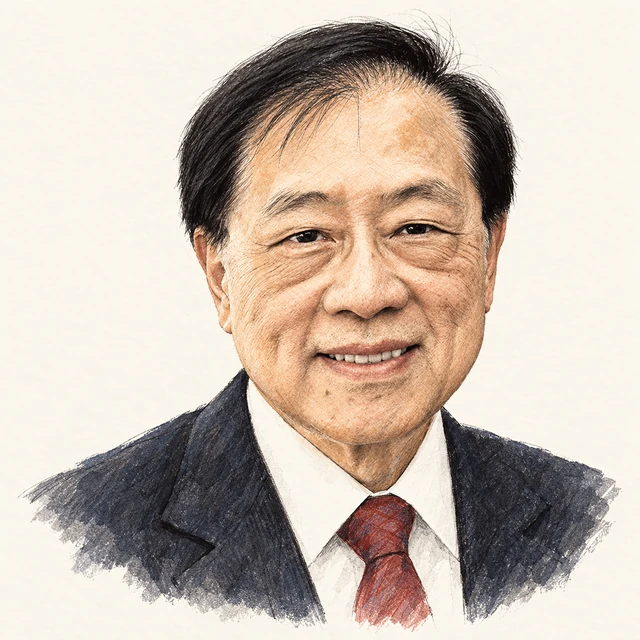
Illustrated portrait of Andrew Yao

Andrew Yao

Andrew Yao developed foundational ideas across computational complexity, cryptography, and communication. His work gave precise ways to study pseudorandomness, the information exchanged during distributed computation, and secure computation between mutually distrustful parties. Trained in both physics and computer science, he held a professorship at Princeton when he received the 2000 award. His later work also helped build theoretical computer science education and research in China.

Read the biography ↗

03 · Read further

From the original sources

Original explanations based on the official award record. The subject label is an editorial navigation aid.

  1. Official ACM profile: Andrew Yao ↗amturing.acm.org
  2. Heidelberg Laureate Forum: Andrew Yao ↗www.heidelberg-laureate-forum.org