c.curionodeThe Turing Archive

2001 · Languages & software

A world of interacting objects

Simula brought objects, classes and simulation together in a programming language.

2001Turing Award
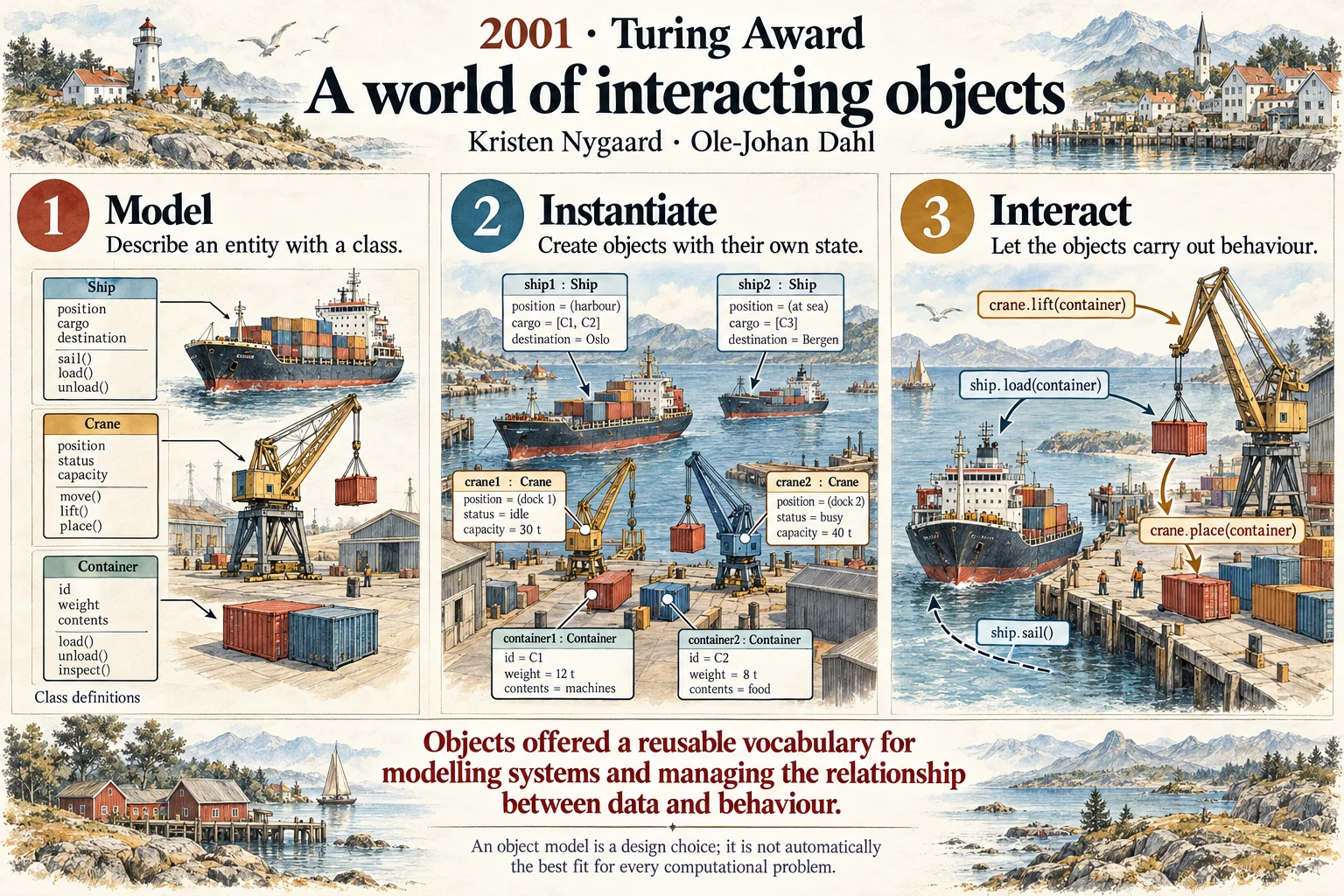
A world of interacting objects: Simula brought objects, classes and simulation together in a programming language.
Original AI-generated infographic by Curionode. Read the text version below for the full explanation.
Read the poster text
  1. Model

    Describe an entity with a class.

  2. Instantiate

    Create objects with their own state.

  3. Interact

    Let the objects carry out behaviour.

Objects offered a reusable vocabulary for modelling systems and managing the relationship between data and behaviour.
An object model is a design choice; it is not automatically the best fit for every computational problem.

01 · The idea

In everyday language

Ole-Johan Dahl and Kristen Nygaard developed Simula, whose ideas helped establish object-oriented programming. A model could contain entities with their own state and behaviour, organised through classes. This approach grew from simulation needs into a general way to structure software.

Why it matters

Objects offered a reusable vocabulary for modelling systems and managing the relationship between data and behaviour.

02 · The people

Who brought the idea to life?

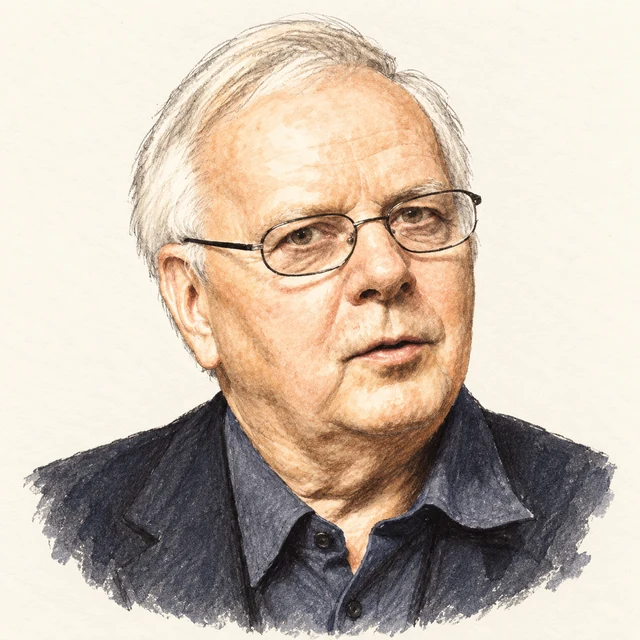
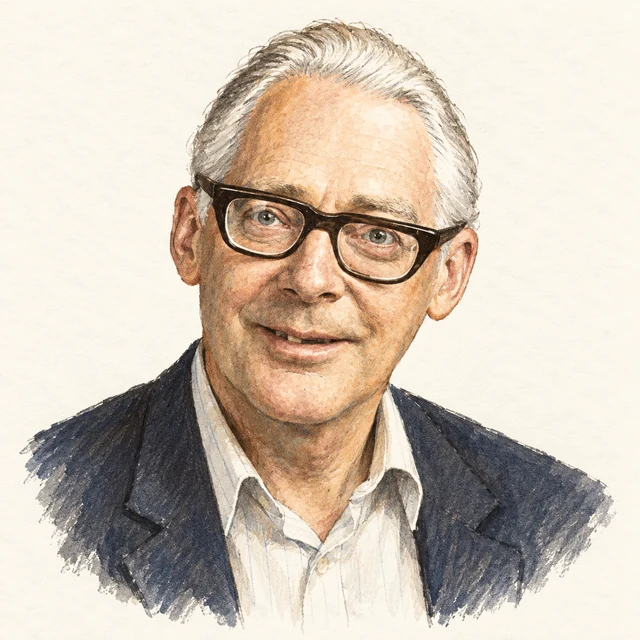
Illustrated portrait of Kristen Nygaard

Kristen Nygaard

Kristen Nygaard approached programming through the need to model complicated real-world systems. At the Norwegian Computing Center, he and Ole-Johan Dahl developed Simula, bringing classes, objects, and inheritance into programming-language design. Nygaard emphasized simulation concepts and the relationship between software and its users. His later research at Oslo included participatory design, continuing his interest in how people help shape the systems they use.

Read the biography ↗
Illustrated portrait of Ole-Johan Dahl

Ole-Johan Dahl

Ole-Johan Dahl combined programming-language theory with the implementation of Simula, developed with Kristen Nygaard at the Norwegian Computing Center. Their work introduced mechanisms for representing interacting objects and organizing related classes. Dahl’s later research at the University of Oslo emphasized rigorous reasoning about programs and object-oriented systems. His contribution joined elegant language concepts with the difficult engineering needed to make those concepts usable.

Read the biography ↗

03 · Read further

From the original sources

Original explanations based on the official award record. The subject label is an editorial navigation aid.

  1. Official ACM profile: Kristen Nygaard ↗amturing.acm.org
  2. Heidelberg Laureate Forum: Kristen Nygaard ↗www.heidelberg-laureate-forum.org
  3. Official ACM profile: Ole-Johan Dahl ↗amturing.acm.org
  4. Heidelberg Laureate Forum: Ole-Johan Dahl ↗www.heidelberg-laureate-forum.org