c.curionodeThe Turing Archive

2002 · Cryptography & quantum

A public lock, a private key

RSA made public-key cryptography a concrete mathematical construction.

2002Turing Award
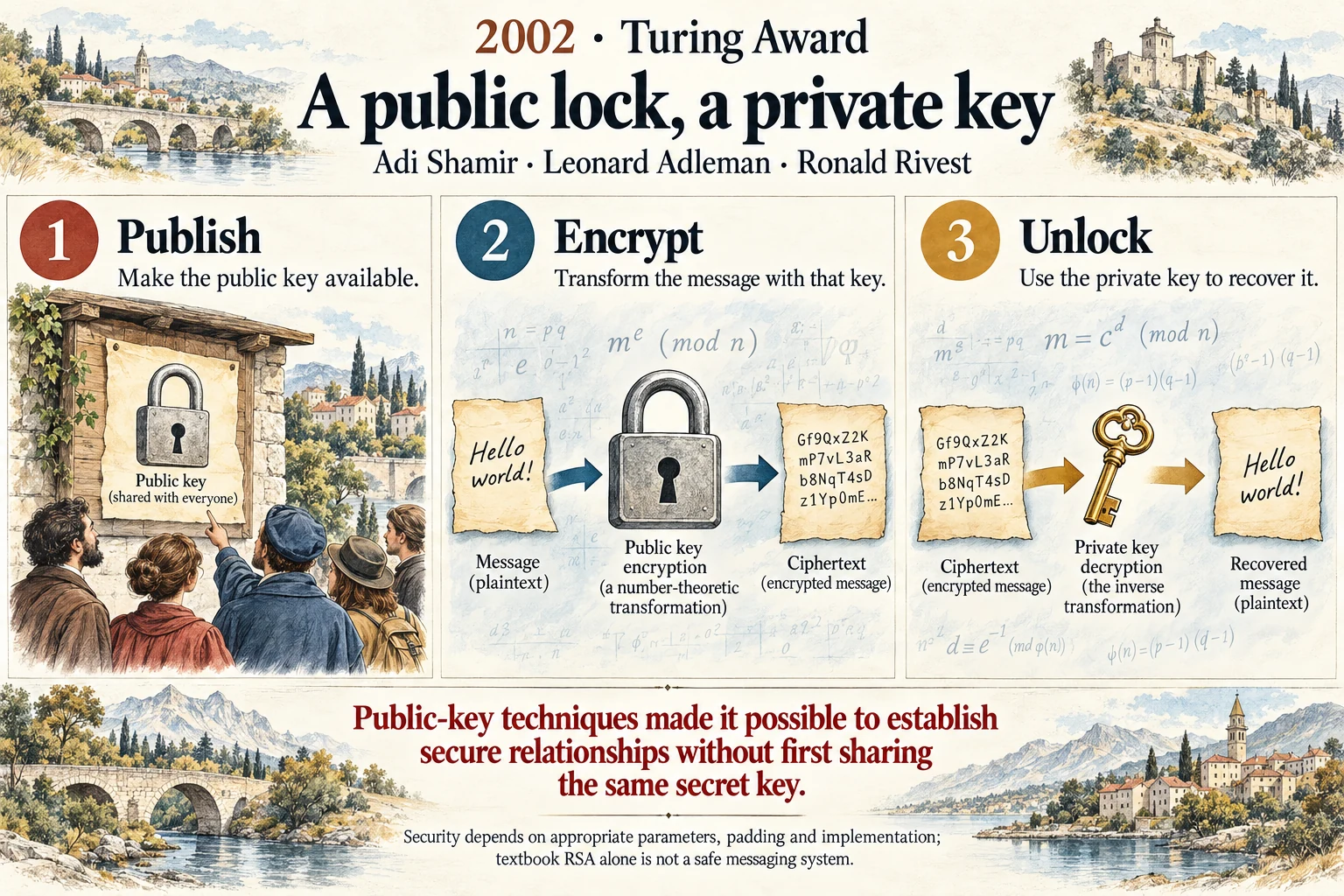
A public lock, a private key: RSA made public-key cryptography a concrete mathematical construction.
Original AI-generated infographic by Curionode. Read the text version below for the full explanation.
Read the poster text
  1. Publish

    Make the public key available.

  2. Encrypt

    Transform the message with that key.

  3. Unlock

    Use the private key to recover it.

Public-key techniques made it possible to establish secure relationships without first sharing the same secret key.
Security depends on appropriate parameters, padding and implementation; textbook RSA alone is not a safe messaging system.

01 · The idea

In everyday language

Ronald Rivest, Adi Shamir and Leonard Adleman developed RSA. Public information can be used to encrypt a message, while a related private key enables decryption. The construction uses number-theoretic operations with deliberately different computational roles, and it also supports digital signatures.

Why it matters

Public-key techniques made it possible to establish secure relationships without first sharing the same secret key.
02 · The people

Who brought the idea to life?

Illustrated portrait of Adi Shamir

Adi Shamir

Adi Shamir co-invented the RSA public-key cryptosystem with Ronald Rivest and Leonard Adleman during their collaboration at MIT. His broader research includes secret sharing, cryptanalysis, and the mathematical foundations of security. At the Weizmann Institute, he continued to investigate both the construction of cryptographic systems and attacks that reveal their limits. His work illustrates how designing protection and understanding weaknesses advance together.

Read the biography ↗
Illustrated portrait of Leonard Adleman

Leonard Adleman

Leonard Adleman co-developed RSA with Ronald Rivest and Adi Shamir, contributing to a practical public-key approach to encryption and digital signatures. His research connects number theory, algorithms, and computational complexity. At the University of Southern California, he also pioneered DNA computing by demonstrating how molecular operations could solve a small computational problem. His career explores computation through both mathematical structures and unconventional physical media.

Read the biography ↗
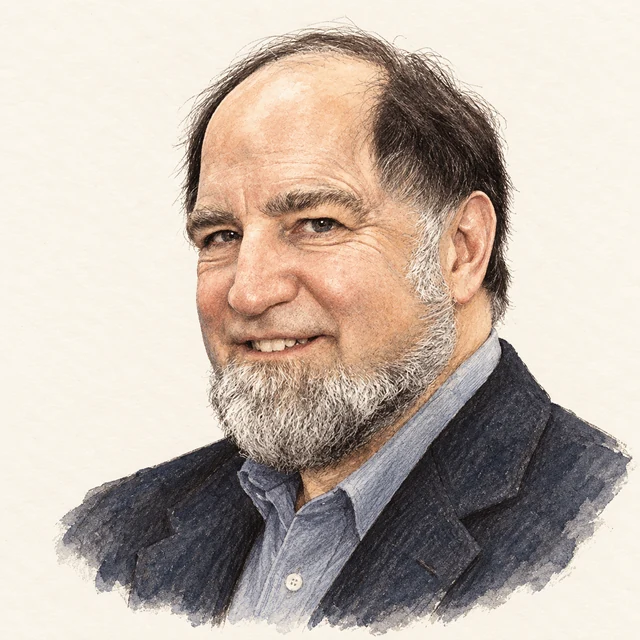
Illustrated portrait of Ronald Rivest

Ronald Rivest

Ronald Rivest co-invented RSA with Adi Shamir and Leonard Adleman at MIT. The system showed how separate public and private keys could support encryption and digital signatures using arithmetic on large integers. Rivest’s wider work includes algorithms, symmetric cryptography, and voting security. He has combined theoretical analysis with practical designs, helping make cryptographic methods part of everyday digital communication and commerce.

Read the biography ↗

03 · Read further

From the original sources

Original explanations based on the official award record. The subject label is an editorial navigation aid.

  1. Official ACM profile: Adi Shamir ↗amturing.acm.org
  2. Heidelberg Laureate Forum: Adi Shamir ↗www.heidelberg-laureate-forum.org
  3. Official ACM profile: Leonard Adleman ↗amturing.acm.org
  4. Heidelberg Laureate Forum: Leonard Adleman ↗www.heidelberg-laureate-forum.org
  5. Official ACM profile: Ronald Rivest ↗amturing.acm.org
  6. Heidelberg Laureate Forum: Ronald Rivest ↗www.heidelberg-laureate-forum.org