c.curionodeThe Turing Archive

2012 · Cryptography & quantum

Proving without revealing

Modern cryptography asks what can be guaranteed—and what can remain secret.

2012Turing Award
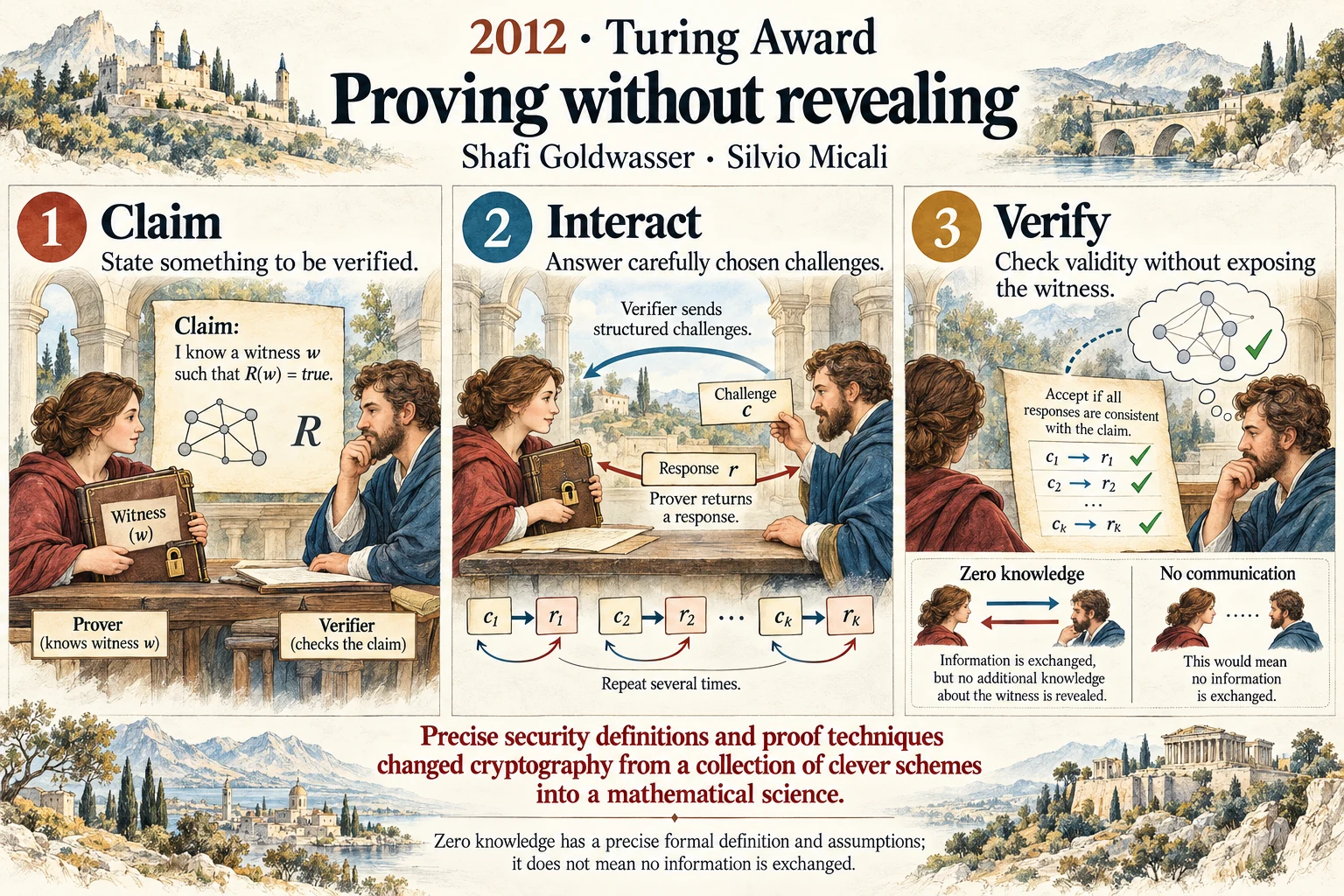
Proving without revealing: Modern cryptography asks what can be guaranteed—and what can remain secret.
Original AI-generated infographic by Curionode. Read the text version below for the full explanation.
Read the poster text
  1. Claim

    State something to be verified.

  2. Interact

    Answer carefully chosen challenges.

  3. Verify

    Check validity without exposing the witness.

Precise security definitions and proof techniques changed cryptography from a collection of clever schemes into a mathematical science.
Zero knowledge has a precise formal definition and assumptions; it does not mean no information is exchanged.

01 · The idea

In everyday language

Shafi Goldwasser and Silvio Micali helped establish rigorous complexity-based foundations for cryptography. Their work included probabilistic encryption and interactive proofs, including zero knowledge. A verifier can gain confidence that a statement is true while learning no additional information from the proof beyond the statement’s validity.

Why it matters

Precise security definitions and proof techniques changed cryptography from a collection of clever schemes into a mathematical science.
02 · The people

Who brought the idea to life?

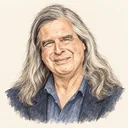
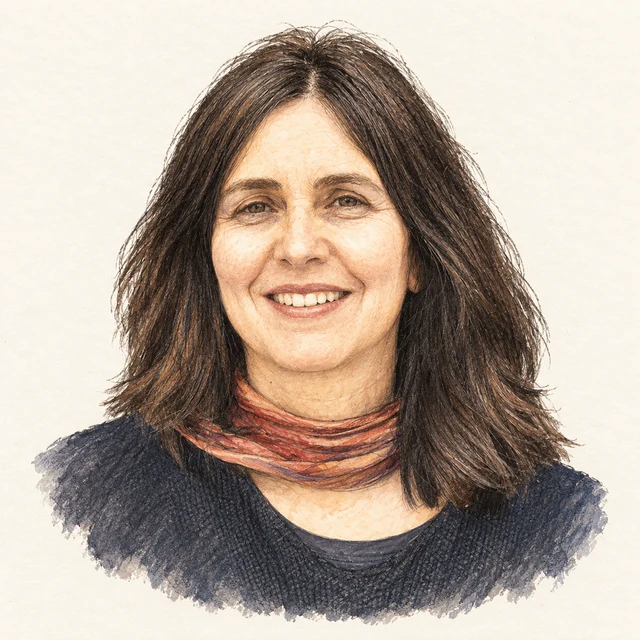
Illustrated portrait of Shafi Goldwasser

Shafi Goldwasser

Shafi Goldwasser helped establish modern cryptography through precise security definitions and mathematical proofs. Her joint work with Silvio Micali introduced probabilistic encryption, while work with Micali and Charles Rackoff introduced zero-knowledge proofs. These ideas showed how randomness can protect information and how a claim can be proved without revealing its underlying secret. She held appointments at both MIT and the Weizmann Institute when the award was announced.

Read the biography ↗
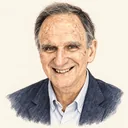
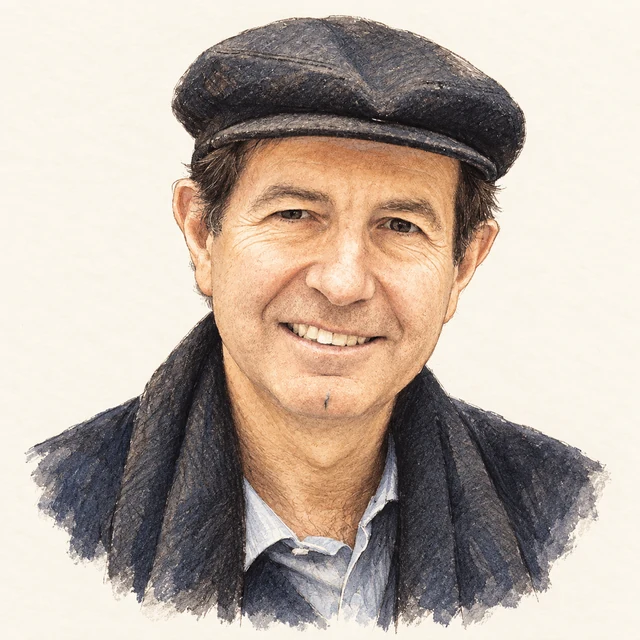
Illustrated portrait of Silvio Micali

Silvio Micali

Silvio Micali helped replace informal cryptographic assurances with definitions and proofs grounded in computational complexity. With Shafi Goldwasser he introduced probabilistic encryption; with Goldwasser and Charles Rackoff he developed zero-knowledge proofs. His broader research includes pseudorandomness, secure protocols, and mechanism design. At MIT, he helped build a theory showing how mutually distrustful participants can compute and communicate while limiting what they reveal.

Read the biography ↗

03 · Read further

From the original sources

Original explanations based on the official award record. The subject label is an editorial navigation aid.

  1. Official ACM profile: Shafi Goldwasser ↗amturing.acm.org
  2. Heidelberg Laureate Forum: Shafi Goldwasser ↗www.heidelberg-laureate-forum.org
  3. Official ACM profile: Silvio Micali ↗amturing.acm.org
  4. Heidelberg Laureate Forum: Silvio Micali ↗www.heidelberg-laureate-forum.org