c.curionodeThe Turing Archive

2015 · Cryptography & quantum

Sharing a secret in public

Public-key methods changed how strangers could establish secure communication.

2015Turing Award

Visual guide

The prize, pictured

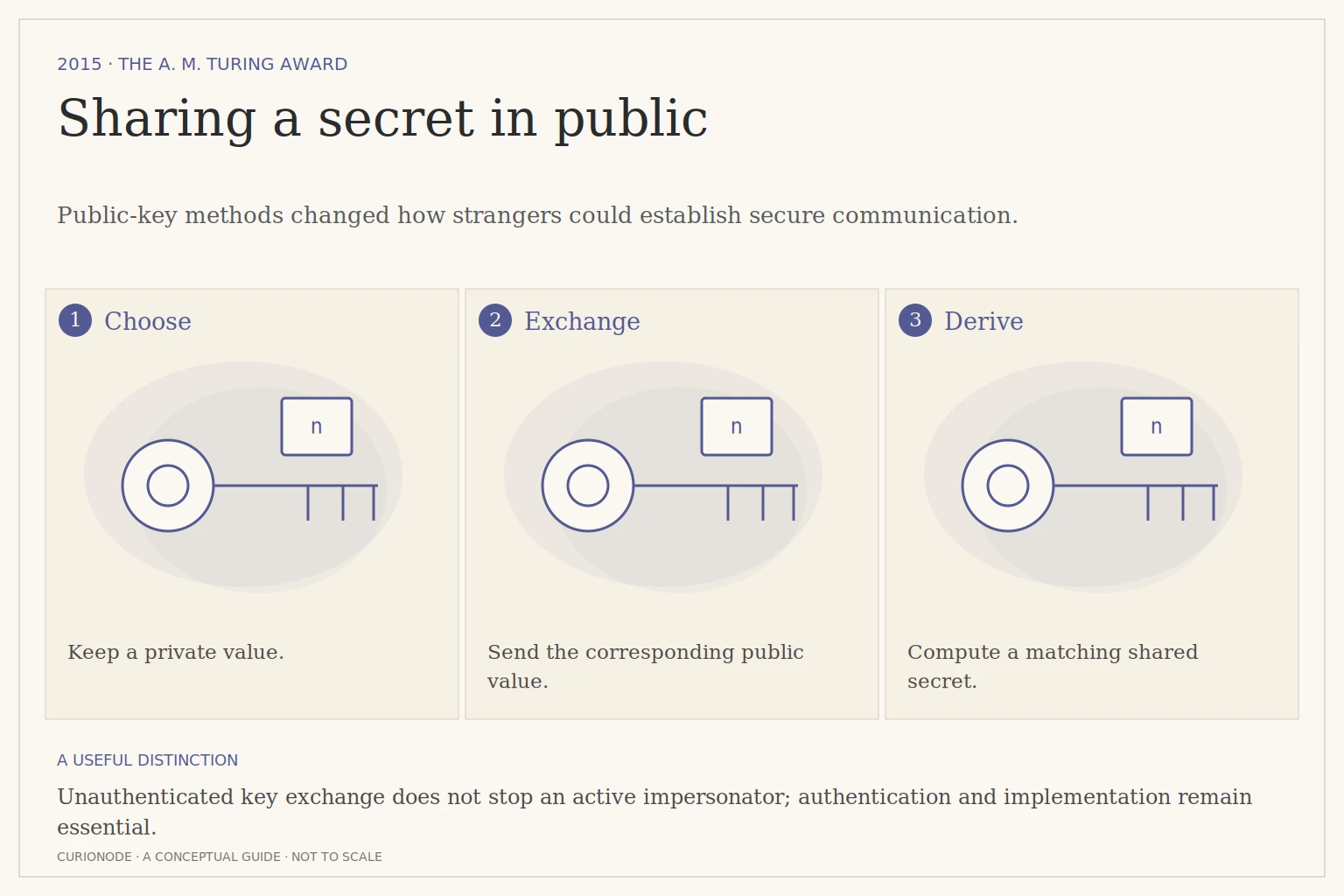
Sharing a secret in public: Public-key methods changed how strangers could establish secure communication.
Original conceptual diagram by Curionode. Read the text version below for the full explanation.
Read the poster text
  1. Choose

    Keep a private value.

  2. Exchange

    Send the corresponding public value.

  3. Derive

    Compute a matching shared secret.

Unauthenticated key exchange does not stop an active impersonator; authentication and implementation remain essential.

01 · The idea

In everyday language

Whitfield Diffie and Martin Hellman introduced foundational public-key ideas and a practical key-exchange method. Two participants can exchange public values and derive a shared secret, while an observer faces a difficult mathematical problem. Their work also set out the role of digital signatures.

Why it matters

Secure communication no longer had to begin with physically distributing a shared secret to every pair of users.
02 · The people

Who brought the idea to life?

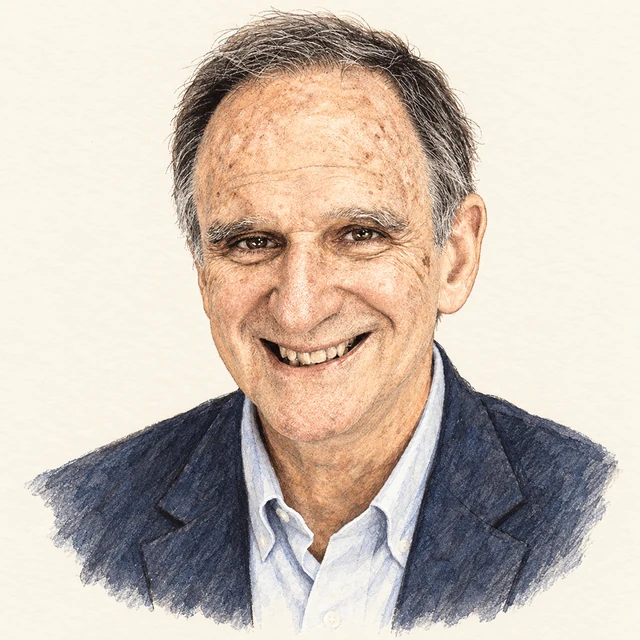
Illustrated portrait of Martin Hellman

Martin Hellman

Martin Hellman co-developed public-key cryptography with Whitfield Diffie and helped introduce a practical method for establishing shared secrets over an open channel. Their 1976 work changed the assumptions of secure communication by separating public procedures from private information. At Stanford, Hellman also supported open academic cryptographic research and later studied international security and nuclear risk, extending his interest in security beyond computer systems.

Read the biography ↗
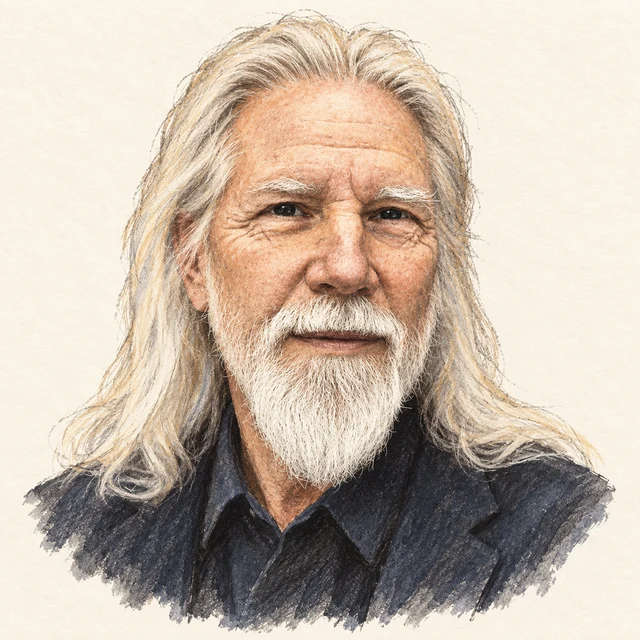
Illustrated portrait of Whitfield Diffie

Whitfield Diffie

Whitfield Diffie challenged the idea that secure communication requires a secret key agreed in advance. With Martin Hellman, he introduced public-key ideas and a key-exchange method that helped transform cryptography into an open research field. His later work addressed computer security, privacy, and public policy. He combined technical invention with advocacy for individuals and businesses to use strong cryptography in an increasingly networked world.

Read the biography ↗

03 · Read further

From the original sources

Original explanations based on the official award record. The subject label is an editorial navigation aid.

  1. Official ACM profile: Martin Hellman ↗amturing.acm.org
  2. Heidelberg Laureate Forum: Martin Hellman ↗www.heidelberg-laureate-forum.org
  3. Official ACM profile: Whitfield Diffie ↗amturing.acm.org
  4. Heidelberg Laureate Forum: Whitfield Diffie ↗www.heidelberg-laureate-forum.org