c.curionodeThe Turing Archive

1994 · Artificial intelligence

Putting expert knowledge to work

AI systems began applying specialised knowledge to demanding real tasks.

1994Turing Award
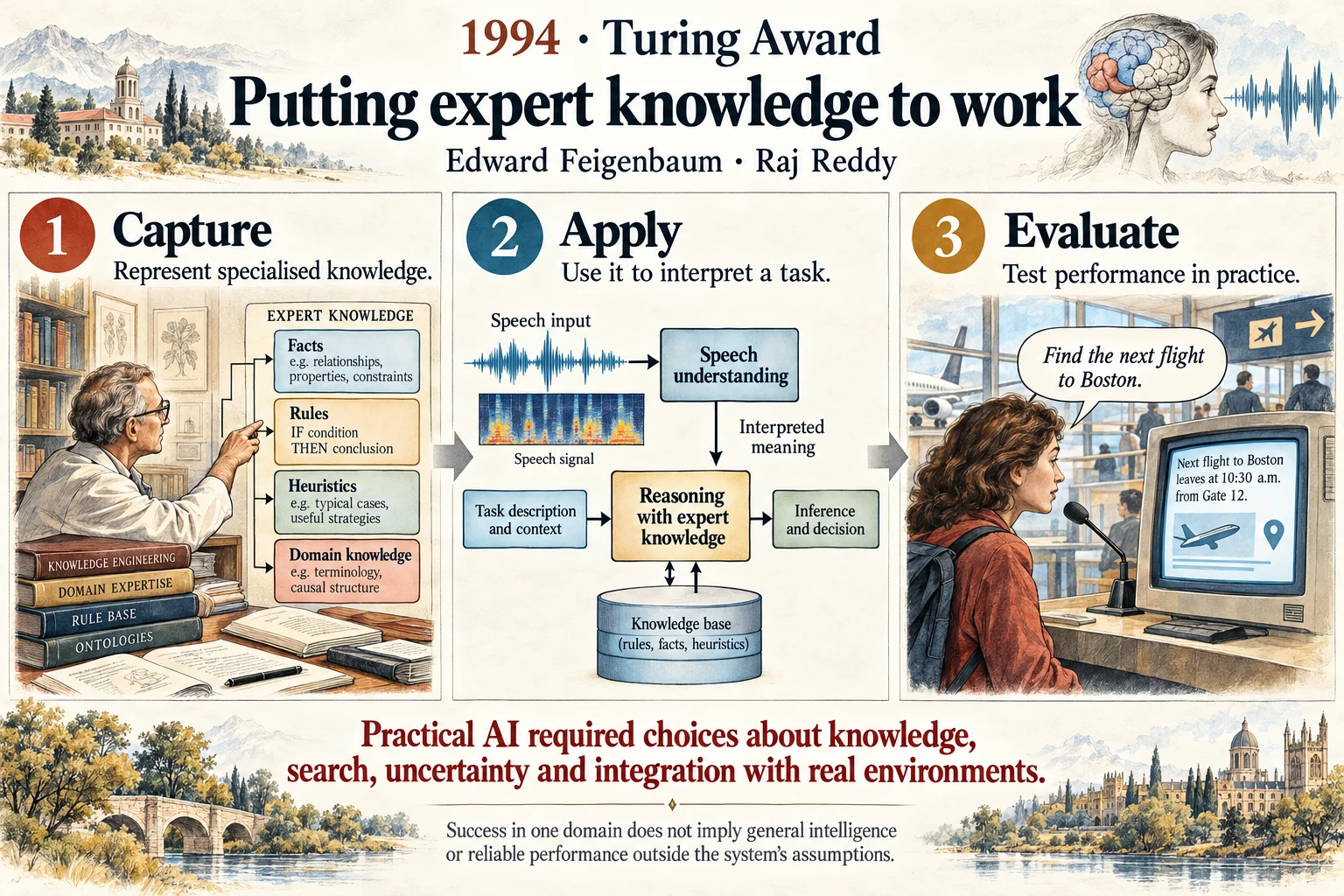
Putting expert knowledge to work: AI systems began applying specialised knowledge to demanding real tasks.
Original AI-generated infographic by Curionode. Read the text version below for the full explanation.
Read the poster text
  1. Capture

    Represent specialised knowledge.

  2. Apply

    Use it to interpret a task.

  3. Evaluate

    Test performance in practice.

Practical AI required choices about knowledge, search, uncertainty and integration with real environments.
Success in one domain does not imply general intelligence or reliable performance outside the system’s assumptions.

01 · The idea

In everyday language

Edward Feigenbaum and Raj Reddy advanced large-scale artificial intelligence systems. Feigenbaum helped develop knowledge-based expert systems; Reddy pioneered work including speech understanding. Their research demonstrated that representing and applying domain knowledge could turn AI techniques into working systems beyond isolated laboratory puzzles.

Why it matters

Practical AI required choices about knowledge, search, uncertainty and integration with real environments.
02 · The people

Who brought the idea to life?

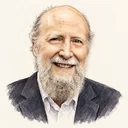
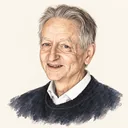
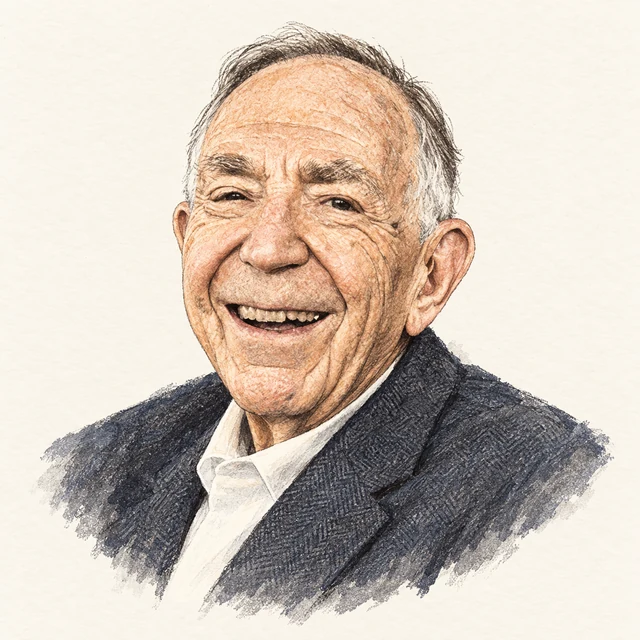
Illustrated portrait of Edward Feigenbaum

Edward Feigenbaum

Edward Feigenbaum helped develop expert systems: programs that use explicitly represented specialist knowledge to solve difficult problems. At Stanford, projects such as DENDRAL showed how detailed knowledge of a domain could support useful machine reasoning. His work emphasized knowledge engineering, including how expertise is acquired, organized, and applied. He shared the award with Raj Reddy for their complementary contributions to large-scale artificial intelligence systems.

Read the biography ↗
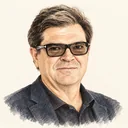
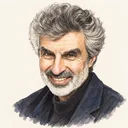
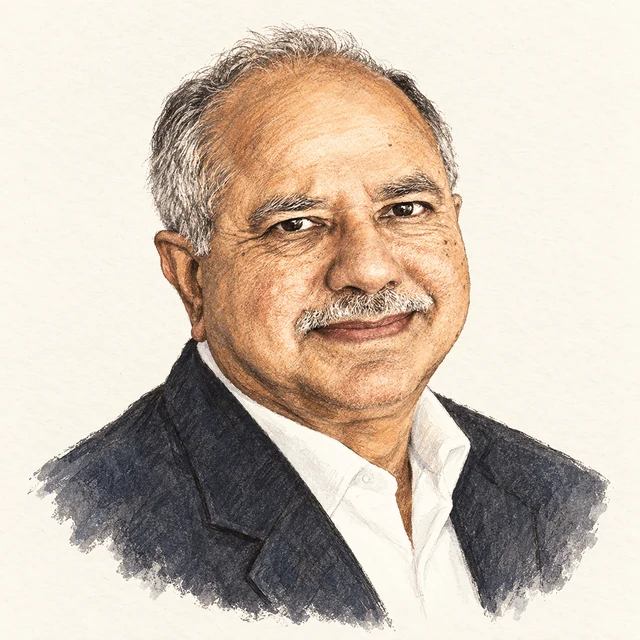
Illustrated portrait of Raj Reddy

Raj Reddy

Raj Reddy pioneered practical artificial intelligence systems for speech and other complex real-world tasks. At Carnegie Mellon, he led research on recognizing continuous speech and helped develop architectures that combine multiple sources of knowledge. His work emphasized building and evaluating substantial working systems, rather than isolated demonstrations. He also helped establish robotics research and trained researchers who extended AI into new applications.

Read the biography ↗

03 · Read further

From the original sources

Original explanations based on the official award record. The subject label is an editorial navigation aid.

  1. Official ACM profile: Edward Feigenbaum ↗amturing.acm.org
  2. Heidelberg Laureate Forum: Edward Feigenbaum ↗www.heidelberg-laureate-forum.org
  3. Official ACM profile: Raj Reddy ↗amturing.acm.org
  4. Heidelberg Laureate Forum: Raj Reddy ↗www.heidelberg-laureate-forum.org